
One Bad Apple
The struggle to rekindle purpose and passion in the kitchen

I came to an unsettling realization this morning, which I promptly expressed to our daughter.
“I think I’m in denial that it’s my job to buy the groceries.”
“That’s really funny,” she said, as she grabbed the last yoghurt cup for her lunch.
Sure, I thought. Until tomorrow morning when we are working to populate lunch kits with a sorry collection of rice crackers and cheese strings, and the Red Delicious apples that were accidentally subbed in for a more appealing apple (i.e., literally any other kind) in our last grocery order.
“What are we going to do with these?” E asked, eyeing the bag on the floor by the refundables. Not even the dog will lower herself to steal them.

“ChatGPT says I can make them into apple butter,” I said, realizing as I spoke the words that I have no interest in making apple butter—or anything—out of these mealy, tasteless blobs. In the same moment, I realize my privilege at feeling all of this towards a (theoretically) perfectly good bag of apples.
But, I ask you honestly, how are Red Delicious apples still even a thing? And who the hell gave them the most misleading name one could offer to a beautifully red shyster? Apparently, I’m not the only one to wonder such trivial things as, in my Googling to find an answer, I came across an article in The Atlantic, of all places, exploring this very topic. And somehow I sit here wondering whether the things that cross my mind have the potential to bear fruit, so to speak, if we’re equating fruit with a byline in a magazine.
My favourite part of all this is the headline:
The Awful Reign of the Red Delicious
How the worst apple took over the United States, and continues to spread
By Sarah Yager
Truer words have ne’er been set to print. Or digitized. Who knows if it made the print edition, though it most likely did since Sarah is a deputy executive editor at the magazine and I suspect a title like that comes with a bit of pull.1 The kind of pull that lets you pitch things like “Why You Look Like Your Dog,” “Why You Can’t Keep a Secret,” and an Atlantic-level deep dive into the union of Taco Bell and Doritos, resulting in this monstrosity.
Anyway, we were talking about apples—or something resembling them. To my surprise, the company that initiated the Red Delicious craze is still in business. It seems, back in the 1890s, people were desperate for a new apple and this thing was the best anyone had to offer. It was initially rejected for how weird it looked but won out due to its flavour. As this may have all of you scratching your heads over what must have been a tastebud affliction back in the day, Yager, again, explains the fall of an American Great.
“But as genes for beauty were favored over those for taste, the skins grew tough and bitter around mushy, sugar-soaked flesh.”
Nevertheless, they persist.
I remember doing journalistic road trips more than a decade ago (maybe even two) and seeing Red Delicious apples overflowing in bowls at every small town hotel’s front desk.
“They probably do that because they know no one’s ever going to take one,” I would have joked to my Globe and Mail counterpart, whose laugh will make you think you’re the funniest person on the planet.2 God help her if she ever meets Seinfeld. (Also, what a gift to find so much in the world worthy of a guffaw.)

As Yager points out, hotel lobbies aren’t the only place these fruits go to die.
“Bumped around the bottom of lunch bags as schoolchildren rummage for chips or shrink-wrapped Rice Krispies treats. Waiting by the last bruised banana in a roadside gas station, the only produce for miles. Left untouched on hospital trays, forlorn in the fruit bowl at hotel breakfast buffets, bereft in nests of gift-basket raffia.”
Amen, sister. It’s for this reason that I could not fathom why the Instacart shopper chose to substitute the elusive Cosmic Crisps I had asked for (on sale for $8.99) with a bag of bruised and sorry little Red D’s (ringing in at $11.49, which must be the result of an unfavourable situation around supply and a distinct lack of demand).
“Who even eats Red Delicious apples??”3 I wrote in my comments on this particularly unsuccessful order. (The container of grapes I ordered also arrived visibly meagre, missing 270 grams of its promised 907 gram bounty.)
Using Instacart for Superstore is a fool’s errand (using the store’s own app is the way to do it, provided you can envision your grocery needs 24-hours in advance). But, as I mentioned at the beginning, I have been in denial so far this year about my role in keeping our pantry, fridge, and fruit bowl stocked and have thus found myself delaying bedtime—twice—while I wait for shitty apples and not enough grapes to arrive so people have something to take for lunch.
“You should probably just go to the store,” my friend said on our dog walk this week.
I know this to be true and yet still, I cannot.4 In fact, I have been subjecting my family to an “eat down the freezer” mission since we returned from Christmas break, in an attempt to avoid grocery-related interactions. At first, no one noticed. But last night, when they were served the same sautéed frozen vegetables three days in a row, our daughter actually opted for salad, something that never happens due to all dressings being “too sour.” The boy did what he always does: ate the protein and claimed to be “too full” for the potatoes and veg.
“I’ll come back to it later,” he promised with his beautiful North Atlantic green eyes. This kid is proof that the reassurance once offered to parents that their children will naturally choose a balanced diet over the course of time is complete horse shit.5
“No you won’t,” I said, understanding that what remained on his plate would make up some form of my next day’s lunch or dinner. Leftovers on Lettuce. Title of my next cookbook.
My care for the culinary is pretty industrial at this point, a sad, anemic version of the experimental cook I used to be, a person who was often gifted Jamie Oliver and Nigella Lawson cookbooks and then spent evenings and weekends poring over their succulence. A person who once hosted a seven-course, gourmet dinner party based on the seven deadly sins. A person who once drove like a mad woman from gymnastics pick-up to some random grocery store in our city’s northwest to meet the gorgeous and gregarious Lynn Crawford, a very confused nine-year-old in tow.
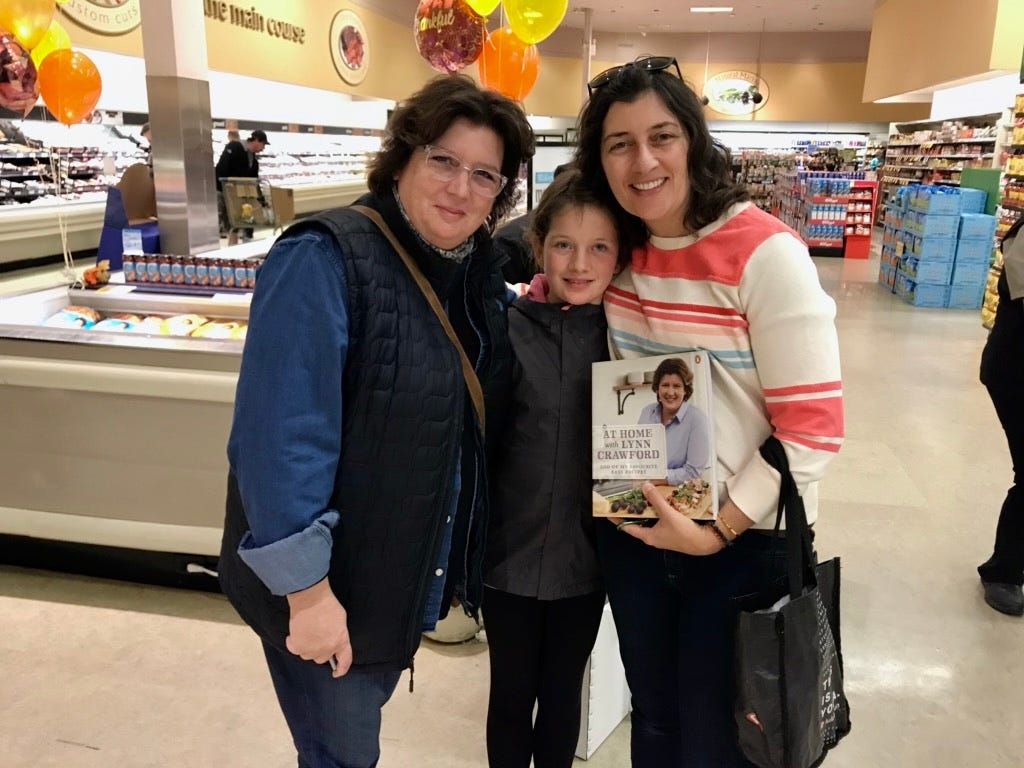
Hilariously, while I was acting like a groupie getting my cookbook signed, a woman who clearly had no idea she was in the presence of a Canadian celebrity chef stopped us to ask if we had any ideas about what to do with salmon. I flipped to the index.
“Page 173,” I told her, making Lynn (first name bestie now) laugh.
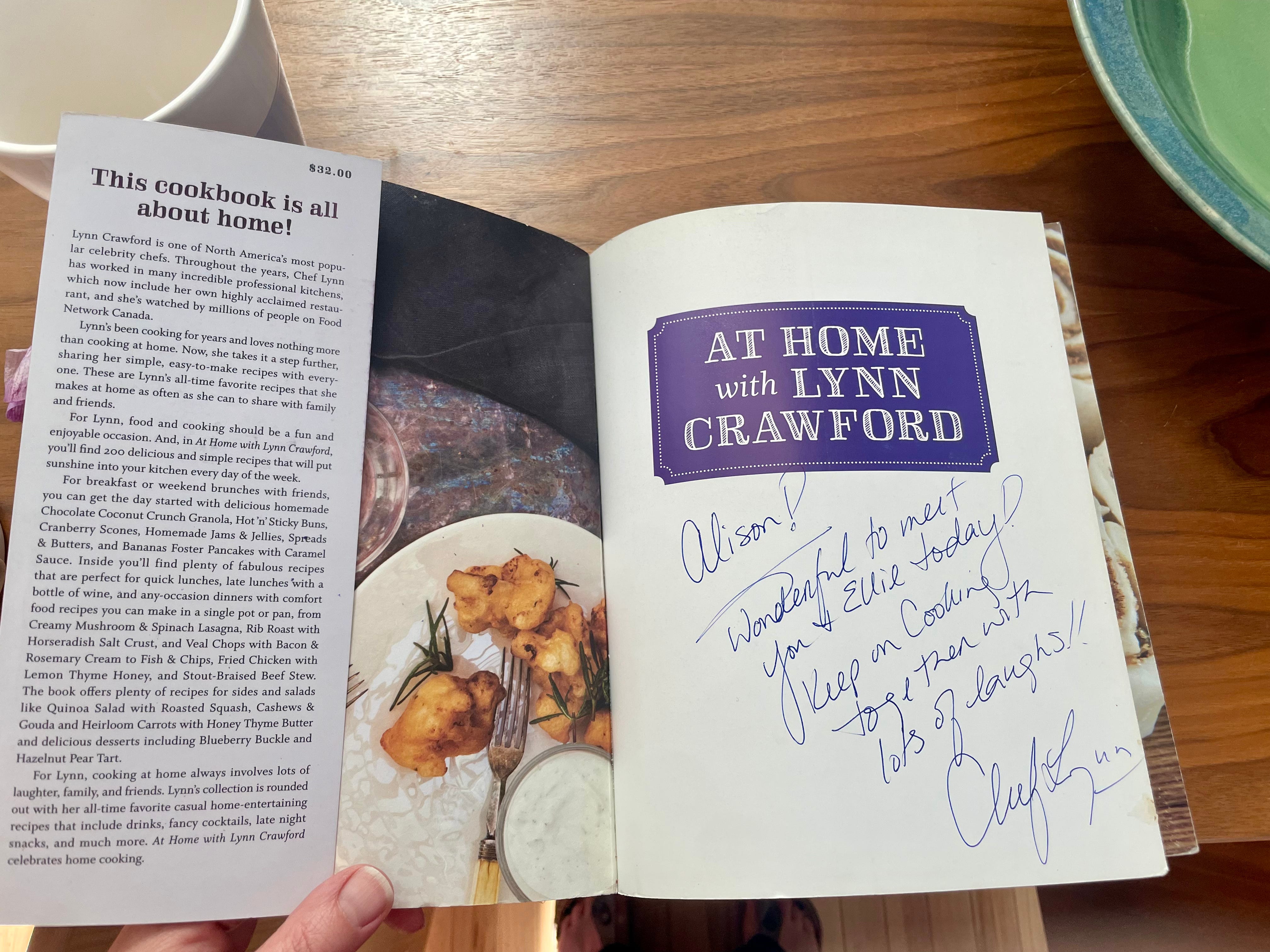
I actually pulled that cookbook out over the Christmas holidays with the intention of teaching our son how to cook a few things. Sadly, it’s falling apart at the seams. Even so, it serves as an adequate text for a new and somewhat interested cook. It’s perhaps me who is more interested in making sure this kid comes down the chute with some kind of skill worthy of adulthood, which I sold to him as an aide to his romantic future.
“The way to a woman’s heart is through her stomach,” I told him, quoting my grocery store advocating friend who is also trying to world-prep a 12-year-old boy.
And so, on day one of our instruction, he made Crawford’s stout-braised beef stew which he served with cheesy biscuits from America’s Test Kitchen’s cookbook for kids. He tapped out near the end of the biscuit portion of the cook, understandable since it was a hefty meal to throw at him on his first day. On another day, we made her buttermilk pancakes (for dinner since, as has been noted, we have no food) but, by “we”, I mean he made the batter and I cooked the cakes. I don’t know why.
It’s hard to understand why my interest in food, its procurement, and its preparation waxes and wanes. I used to care a lot about making delicious food. And, for a couple of weeks in December, I did, again. Now I hardly even care if there’s food in our house. So I guess I—and everyone around me—will just have to wait until my pendulum decides to make its way back to the kitchen.
I will, however, maintain my standards around apples.
PITCH COUNT: 1 REJECTION COUNT: 0
She’s the kind of person who gets her engagement announced in The New York Times.
Perhaps I am.
This is the problem. Cause the answer is: lots of people. Somehow this apple still accounts for 13% of American apple production, second only to Gala (16%), another apple that finds no love in my heart. For this bit of information, I spent more time than one might expect a housewife/SAHM to do perusing the USApple Industry Outlook 2025. To my delight, it includes a section titled, “Core Findings.” I love it when numbers people find their punny bone.
I have a really hard time executing errands.
The history behind this belief is quite fascinating and should likely be made into some kind of movie. The Reader’s Digest version goes as follows: 1920’s American paediatrician, Clara Davis, amasses a collection of orphaned or “donated” babies upon whom to perform a dietary experiment that goes on, in a few cases, for more than four years. Hardly shocking, until you understand the variable control of the experiment required these 15 babies to live at the hospital with little to no contact with the outside world, should their dietary choices be influenced one way or another. In the end, Davis did adopt two of them. Lord knows what she served for dinner.
I’m so glad you mentioned the horrors of gala apples in your footnote. I don’t know what happened to them. They used to be delicious! Maybe red delicious used to be delicious and our depleted soil has made them mealy and gross? Maybe another apple-related rabbit hole for you to go down. Loved this!
And see as a kid I LOVED a red delicious apple because all we could getting the Yukon in the early 80s was a Macintosh - and to me, a RD was such a treat! Now I am an Ambrosia/Gala/Pink Lady type of girl.